Shelter in place or evacuate? How to increase your chances for survival in a hurricane
HONOLULU (HawaiiNewsNow) – Large-scale emergency evacuations are fraught with problems, especially around urban Honolulu.
Read more Why preparation matters when disaster response is delayed
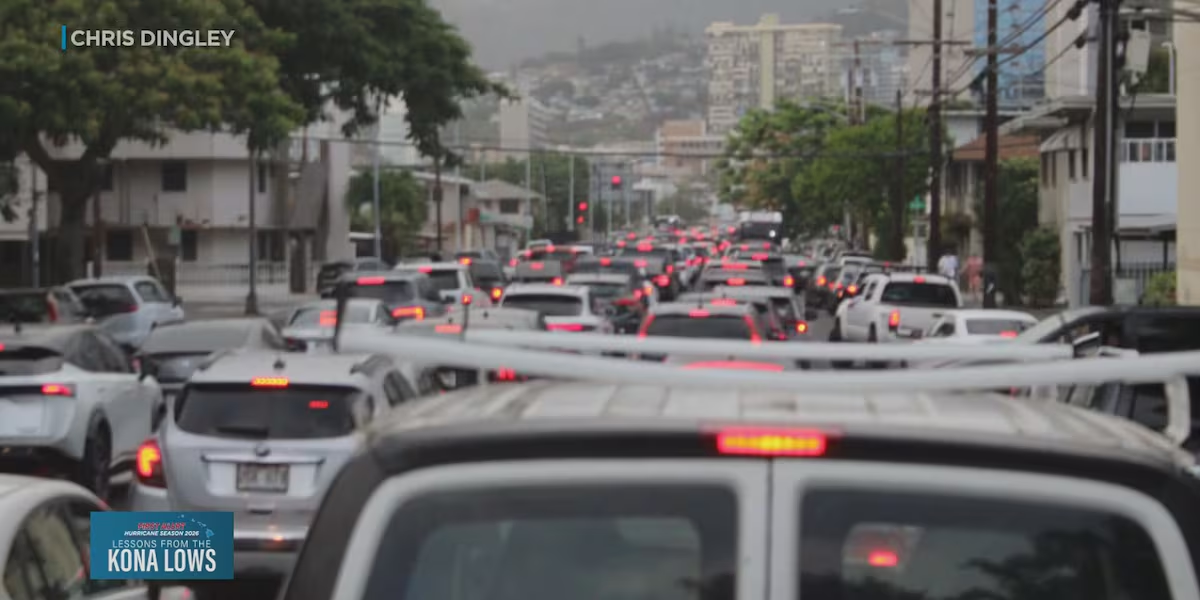
That was painfully evident during last July’s tsunami warning, when thousands of vehicles caused chaotic traffic gridlock as everyone tried to leave tsunami zones along the coastline all at once.
A day after the warning, Honolulu Transportation Services Director Roger Morton told Hawaii News Now, “The problem was, no matter how much green (traffic signal) time we provided, if the traffic was crawling, it could be 100% green time and the cars couldn’t get through because the traffic was congested.”
More time for evacuation preparations
Those evacuations came with little notice, but hurricanes and tropical storms offer one key advantage: time.
“We’re tracking this system. We know that it’s approaching. The hurricane is not going to be like one of those ‘five hours and tsunami,’” said Hawaii Emergency Management Agency administrator James Barros.
It’s also different from the flash flooding during March’s Kona low storms, which gave people almost no time to prepare in several neighborhoods.
“When you think about it, it hit North Shore — Waialua, Haleiwa. It got Maui. It got parts of the Big Island. And then a couple of days later, Manoa gets it,” said Barros.
But a hurricane or tropical storm could impact a larger area with destructive winds that could extend several miles from the center of the system along with heavy rain.
MORE: First Alert Hurricane Season 2026: Lessons from the Kona lows
Older, wooden homes at risk
Many homes in Hawaii are older and some are single-wall wood construction. So that begs the question: if a hurricane comes, do you shelter in place? Or do you evacuate? And if so, where to?
Experts estimate there are nearly 200,000 homes constructed with wood in the state, including single-wall homes.
“I rent a storage space,” said Barros. “We get storage spaces all over. All my opala that’s in my storage space, that’s going to be safe because i’s a hardened building. But the house I live in — Cat 3? Might be pushing it.”
Don’t rely on hurricane refuge areas
There are what officials call “hurricane refuge areas.” But it’s a last resort for people who don’t have a safer place to ride out a hurricane or tropical storm.
Read more State finalizes agreement to acquire Wahiawa Dam and irrigation system
“We don’t have hurricane shelters across the state. We just don’t have enough to shelter everyone,” Barros said. “So what we’re looking at is more of a kakou effort, that it’s everybody in this sheltering mission.”
Part of that effort starts with your own home.
“Strengthen your home first,” Barros said. “Try to figure out how you can employ hurricane clips, hurricane straps. How do I secure the windows?”
If you aren’t able to do that, Barros said you should look elsewhere. For example, high-rise condos are an alternative to take refuge.
“Do I have a family member who lives in a hardened building? Somebody that lives in urban Honolulu? The buildings are hardened. You just go in here, stay away from the glass windows, and you’ll be okay,” he said.
Emergency officials say hotels and resorts along the shoreline in Waikiki are also safe for a so-called vertical evacuation, where you’re high enough to avoid a storm surge.
There have also been talks with businesses in office buildings in areas like downtown Honolulu.
“When we talk to a business, too, they don’t want to be an American Red Cross shelter for anybody to come in. But can you be a shelter for your employees and their families?” said Barros.
“If you’re a campus (like the) University of Hawaii, you have hardened buildings. We’re not asking you to shelter everybody on the island, but what about your faculty? What about your student population? Give them a safe place, a ‘hunker down,’ safe place to be,” he said.
Officials beefing up notification services
The tsunami warning and the Kona lows have also prompted emergency officials to strengthen the ways that keep you informed.
“We want to ensure that our notification systems are solid across the state, from the scientists at the National Weather Service down to the state, down to the counties and out to our communities,” said Barros.
Read more ‘We felt hollow’: Otake Camp flood survivors urge preparedness





Post Comment