What Hawaii can learn from Super Typhoon Sinlaku
HONOLULU (HawaiiNewsNow) – March’s Kona low storms showed the damage a slow-moving system can bring to Hawaiʻi. In April, an even more powerful tropical cyclone in the western Pacific crawled across the Mariana Islands, leaving widespread devastation.
Read more Shelter in place or evacuate? How to increase your chances for survival in a hurricane
Experts say it shows what can happen when powerful systems strike isolated islands.
“Super Typhoon Sinlaku was a powerhouse storm, one of the strongest on the globe that we’ve seen in all of 2026,” said Landon Aydlett, a National Weather Service warning coordination meteorologist.
The storm’s impacts were immediate and widespread.
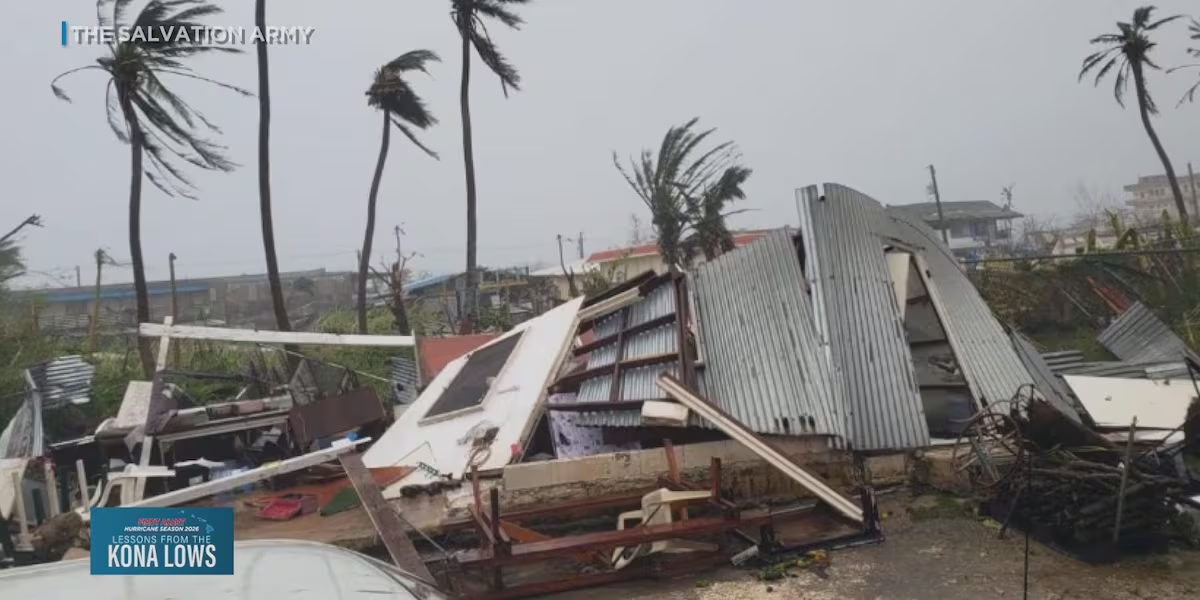
“You see downed poles, basically every tree is downed. Roadways are obstructed, we also had a major road collapse at the entrance of a major village,” said Thomas Manglona III, founder of Marianas Press.
Sinlaku claimed 17 lives and displaced thousands, making it the deadliest storm in Micronesia since 2002.
While Manglona has covered many disasters, he said this one was especially difficult.
“Crawling as I was communicating to people as this thing was passing, most people can outrun this typhoon,” said Aydlett.
The storm’s duration led to real devastation. Sinlaku crawled over islands like Tinian and Saipan at just 2 to 3 miles per hour, hammering the islands for three and a half days.
“The fact it took so long, many people were more scared of this storm than they were of Super Typhoon Yutu and previous storms before it,” Aydlett said. “That says a lot because Yutu hit them as a 175 mph super typhoon. This one was a strong category 4 at 145 mph.”
MORE: First Alert Hurricane Season 2026: Lessons from the Kona lows
Saipan resident Derek Cutting, a former Hawaii resident, said the storm disrupted daily life and left many communities without power.
“This storm really put a huge impact on the way life is in Saipan. It was the longest storm literally. Government’s pretty much shut down. My entire village does not have power at all yet,” Cutting said. “If you look outside now, every single tree is about six feet tall.”
Saipan’s power grid took a massive hit with more than 600 poles down, leaving thousands without power or water for months.
“Some areas have power, but because there’s no transformer on a lot of the poles, a lot of houses or businesses don’t have power, even though there’s power on the street,” said Cutting.
“Anything that was not reinforced concrete was heavily damaged or nearly destroyed,” Aydlett said.
At the peak of the storm, two National Weather Service Guam generators failed, forcing National Weather Service Hawaii to take over operations for several hours. Sensors and rain gauges were also destroyed by the elements.
Read more Why preparation matters when disaster response is delayed
Meteorologists had to rely on satellite-based remote sensing for rainfall estimates, Aydlett said.
Even after the storm passed, deadly hazards remained.
“We had two lives lost here on Guam. That was after the typhoon’s passage due to carbon monoxide poisoning from generator use,” Aydlett said. “So when it comes to hurricane threats in Hawaii, make sure you know how to use a generator properly. Do not use it inside your home.”
Hawaiʻi sends aid as recovery continues
Weeks after Sinlaku, only 50 percent of Saipan had power. In the aftermath, relief from Hawaiʻi supported recovery efforts.
The Northern Mariana Islands (NMI) Club of Hawaiʻi partnered with Matson to ship storm recovery goods to families across the Northern Mariana Islands.
“We want to make sure that we’re also extending the aloha across the ocean and we’re just grateful for the opportunity to be able to do this with the support of our partners,” said LJ Duenas, a volunteer with the NMI Club of Hawaiʻi.
Volunteers Maisie Tenorio and Asia Camacho Hilario said the effort was moving.
“Near and far, we work better together and it’s just so beautiful to witness,” they said. “Inside the doors of the container, there were letters written by kids with pictures and everything. And it was just so emotional.”
Training across the Pacific highlights preparedness
Supplies aren’t the only bridge connecting the islands.
For the past 25 years, meteorologists from across the Pacific have traveled to Hawaiʻi to train with the National Weather Service Pacific Desk.
“Our purpose is to interact with folks from across the Pacific, but that’s not just one way,” said Jennifer Strahl, a National Weather Service Pacific Desk cohort meteorologist instructor. “We’re obviously helping to build capacity in these MET offices, but we’re also gaining knowledge from the participants that come. We want to enable them to be more resilient as a community.”
“There’s a lot of lessons learned,” said Kaiekeke, a Kiribati meteorological office representative.
For years, the cohort has partnered with Hawaii News Now to highlight the vital role of communication during severe weather events.
“I can’t wait to apply everything that I’ve learned here in my own island,” said Maunana, a Kiribati meteorological office representative.
As a developing El Niño takes shape, experts say the need to prepare across the entire Pacific is even more critical.
“We don’t know what 2026 is going to bring us, especially this El Niño, but we are anticipating a lot of activity across the west Pacific, central Pacific, eastern Pacific,” Aydlett said. “And who knows which island is going to be taking a hit next. So we always have to be prepared.”
Read more State finalizes agreement to acquire Wahiawa Dam and irrigation system





Post Comment