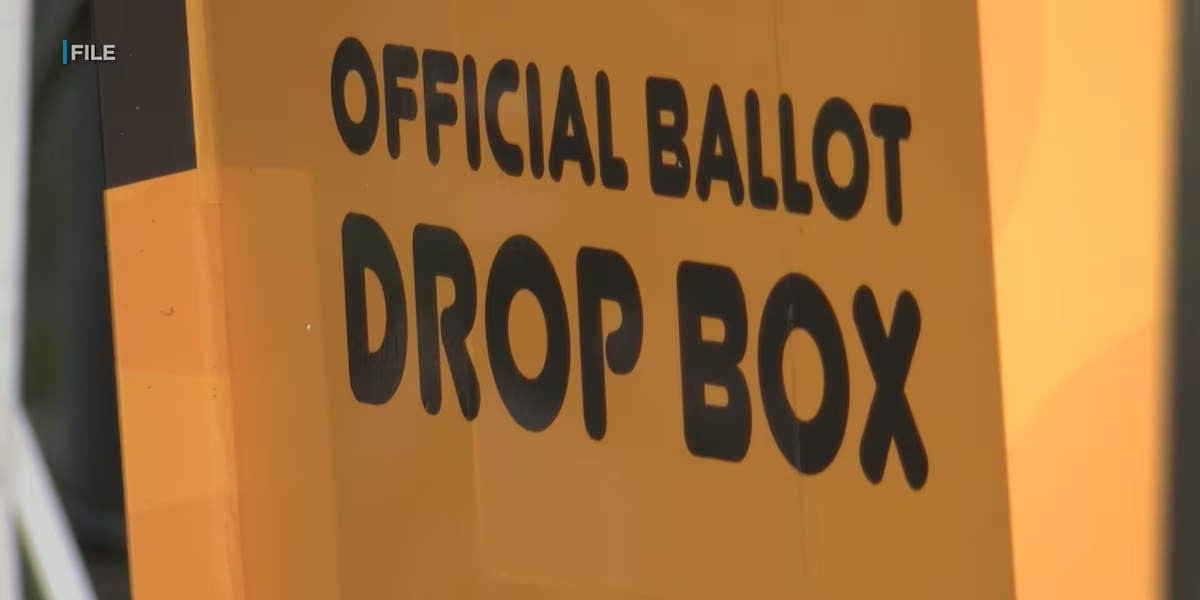
What to know about Hawaii’s primary election: Ballots, voting centers, results
HONOLULU (HawaiiNewsNow) – With the primary election approaching Aug. 8, state and city election officials are urging voters to watch for their mail ballots, follow ballot instructions closely and return ballots early.
Read more Kauai festival honors island’s plantation roots in Koloa
When ballots arrive and when to return them
Honolulu elections administrator Rex Quidilla said ballot mailings were scheduled to drop on July 16 and 17, with some potentially arriving as early as the next day.
Voters have until 7 p.m. Aug. 8 to return their voted ballot to their County Elections Division by:
Quidilla said those who choose to return their ballot by mail should note, “USPS guidance is about a week before. It travels a little quicker than that, though, but I wouldn’t risk it.”
If you are in line at a voter service center by the time voting closes at 7 p.m. you will still be allowed to vote. Officials will mark the end of the line, and anyone who leaves will not be permitted to rejoin.
View an interactive map of 2026 voter service centers and places of deposit (drop boxes).
In addition to two full-time voter service centers at Honolulu Hale and Kapolei Hale, Quidilla says two pop-up voter service centers will be open in Wahiawa and Kaneohe from Monday, Aug. 3, through Friday, Aug. 7, 9 a.m. to 5 p.m.
“We usually open the Kaneohe (center), shut that one down, and then Wahiawa follows it,” Quidilla said. “The idea was to keep it open closer to the election, we might get more interest.”
On the go? Listen to the full interview as a podcast:
Party choice matters in Hawaiʻi’s primary
Hawaiʻi runs a single-party primary election, which means voters should first select their party on the ballot and then vote only within that party.
“The important thing to do is select your party, because we are a single-party primary election. Select your party first and then only vote in that party you selected,” state chief elections officer Scott Nago emphasized. “You can only vote for one party as well as the non-partisan candidates on the back, or contests on the back.”
Officials note that choosing a party on the primary ballot is not a commitment to that party in the Nov. 3 general election.
“In the general, it’s a little different because you can vote for any party in any contest,” Nago said.
Don’t forget to sign the return envelope
Quidilla stressed voters must sign the return envelope, calling it a legal requirement, and said there is a curing process if a signature is missing.
Read more Voters and candidates meet face-to-face at primary election forum
“They should sign the envelope. It’s the law,” Quidilla said. “We can’t accept a blank envelope. So make sure you do, but we’ll follow up with you if you didn’t.”
Quidilla said his office compares the signature on the return envelope to a previously submitted signature, such as one on a voter registration form.
DOWNLOAD: (also available in multiple languages)
How ballots are kept private, and how they’re counted
Nago said ballot packets include a secrecy sleeve and that election workers use a two-step process to separate identifying envelopes from ballots.
“It’s almost impossible for us to know how you voted because of that secrecy sleeve that protects your vote,” Nago said. “Once we remove the ballot from the envelope, we have no way of knowing which ballot is tied to the envelope.”
Nago said ballots are transported in sealed boxes to counting centers in each county — including the state Capitol — where they are counted on high-speed scanners. The results are compiled to produce a statewide report.
RELATED POST: Hawaii officials defend local election security
When results are released
Officials said results cannot be released until voting has completed, meaning the first results depend on when the last voter finishes voting.
“State law prohibits us from releasing results until voting has completed. So we have to wait till the last voter has voted, which, like I said, historically has been as late as 11:30 (p.m.),” Nago said.
Quidilla said long lines are typically seen during presidential elections, which are not taking place this year.
Still, he urged in-person voters to go early: “If you want to do it, do it early. You’re in and out in minutes. But if you come on the last day, prepare to wait a little while. It’s like anything, right? When you go at peak demand, there’s going to be a wait.”
Be sure to follow Hawaii News Now on air, online, and via our mobile app to get the results as soon as their released.
Tools to check your registration, ballot status and candidates
Voters can check their registration online and sign up for BallotTrax, a ballot tracking tool that can send updates by phone, text or email.
Read more Rocky’s 16th monk seal pup to end nursing period soon
Use the state’s to learn more about the voting process and candidates.
Visit the Hawaii Office of Elections website for more information.






Post Comment