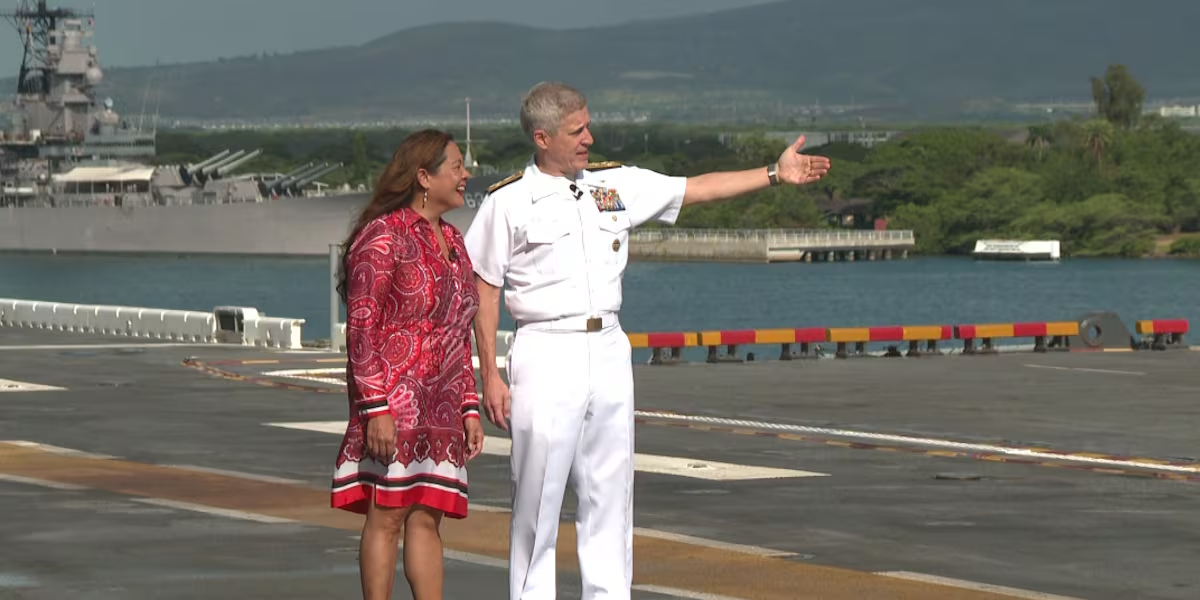
Pacific Fleet commander on building relationships during 30th RIMPAC exercise
HONOLULU (HawaiiNewsNow) – The U.S. Navy Pacific Fleet is hosting the world’s largest maritime exercise in and around the Hawaiian islands with more than 30 nations, and its commander says the 30th iteration comes at a significant time as the United States marks 250 years as a nation.
Read more Aloha Stadium steel begins journey to recycling
Adm. Stephen Koehler shared some of his priorities in an exclusive interview with Hawaii News Now’s Annalisa Burgos on the flight deck of the amphibious assault ship USS Essex, currently docked across from the USS Theodore Roosevelt aircraft carrier in Pearl Harbor.
RIMPAC: building relationships through training
Koehler says the biennial Rim of the Pacific (RIMPAC) exercise, which runs through July 31, is more than just a show of combat power — it’s a sharing of cultures and democratic values.
“This is where sailors come together and have an opportunity to build relationships and then across multiple navies we get this opportunity to operate together and continue to be a better maritime force,” he said.
RELATED POST: RIMPAC maritime exercise kicks off with 31 nations, 25K service members
“Pearl Harbor is full behind us with multinational ships,” he added. “When you look across the exercise that really began as kind of a humanitarian disaster response exercise bringing a bunch of nations together. Now we have complex capabilities by all different scopes and scales of nations, and we bring all of these 30 nations in.”
“There’s an opportunity for them to get what they need out of the exercise,” Koehler added. “Whether that be high-end war fighting and employing missiles and those things to humanitarian and disaster response to amphibious exercises which we’ll do off this ship. All of those things are available for countries to participate in and all of it make it better for all of us.”
Pacific Fleet priorities and the China challenge
As Pacific Fleet commander, Koehler oversees 200 ships, 1,500 aircraft, and 150,000 personnel — 60% of the Navy’s forces.
But China’s navy now surpasses America’s in number of ships.
“They’ve built a global-sized navy. It’s on par and larger numbers of ships than the United States Navy at the moment,” Koehler said. “We have a global responsibility. And so as we look across that, there are opportunities for us to continue to engage with allies and partners like we have to be present and ready.”
As head of Pacific Fleet, Koehler says he works to “build and maintain combat credible forces” so they can respond all over the globe where needed, “employ that capability” to deter conflict, assure and work with allies and partners, and “build out our posture and our capabilities in the Pacific.”
Read more Lahaina hosts first Little League tournament in 18 years
Which is why boosting shipbuilding and working with allies are more important than ever.
“As we’ve seen in the administration here, they’re pushing very hard for an increase in shipbuilding,” Koehler said. “What we’re blessed with here at the Pearl Harbor shipyard is what I think is the best performing shipyard certainly in my claimancy, and you know we are getting ships and submarines out on time. That’s in a repair capacity.”
“In an overarching shipbuilding capacity, I think we need a bigger fleet. I think we need more ships. I think we have to continue to build out the industrial base to do that. And the best way to do that is to put the demand signal and provide competition.”
Global demands and Indo-Pacific readiness
When asked if the Middle East conflict has pulled focus away from the Indo-Pacific, Koehler says having “the adaptability and flexibility of sending [forces] where the national command authority wants is my job.”
He added that Pacific Fleet is able to juggle multiple priorities, including the Balikatan exercise in the Philippines, Pacific Partnership exercise throughout Vietnam, Malaysia, Timor-Leste and Fiji, and the Valiant Shield exercise in the Western Pacific.
Red Hill, environmental stewardship and rebuilding trust
When asked about managing the fallout and cleanup of the Red Hill fuel crisis, Koehler says environmental stewardship is a priority under his leadership at Pacific Fleet.
“The Navy here, Pacific Fleet remains committed to the permanent closure of Red Hill and all of the transparency that we continue to work with the populace of Hawaii, Department of Health, EPA, all of those things are partners in ensuring this is done correctly and so that commitment remains,” he said.
The Navy says it remains committed to rebuilding trust with Hawaii communities while maintaining its mission across the Pacific.
Catch more of HNN’s exclusive interview with Adm. Koehler Saturday at 7 a.m. on Sunrise on K5.
Read more Settlement talks set for state, family of Peter Boy Kema in wrongful death case




Post Comment