State defends Medicaid fraud unit after vice president’s criticism
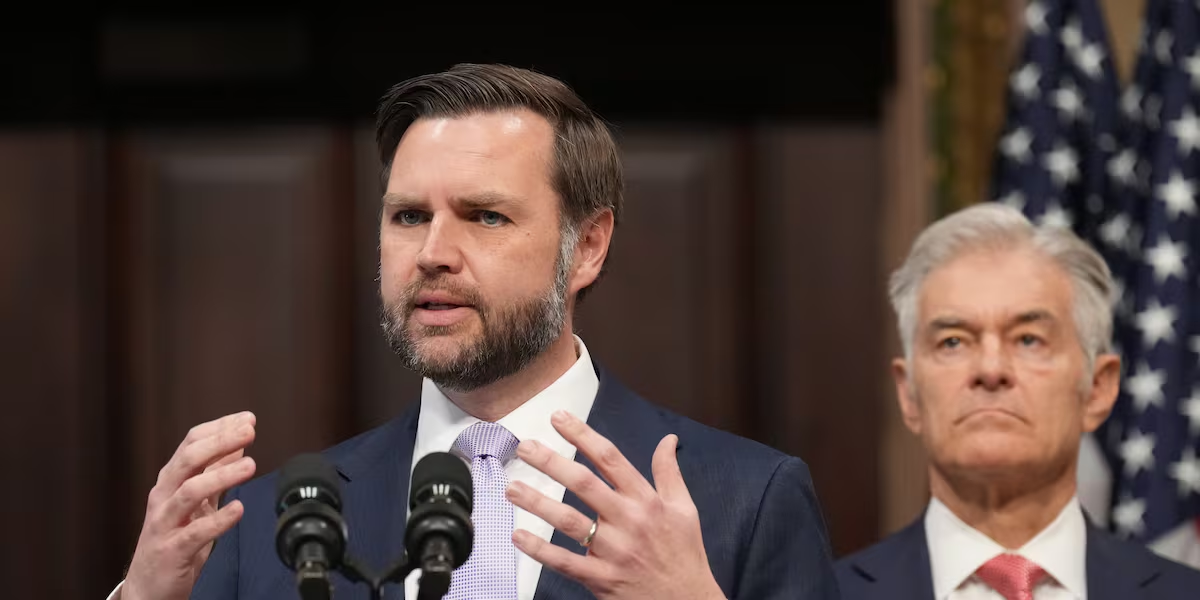
HONOLULU (HawaiiNewsNow) – Vice President J.D. Vance called Hawaii’s Medicaid fraud enforcement a “complete disgrace” and threatened to cut federal funding to the unit, which receives more than $2 million annually but has produced zero criminal convictions in recent years.
Read more Honolulu Police Chief candidates take questions from the public in live forum
Hawaii’s attorney general strongly denied the characterization.
Hawaii’s Medicaid Fraud Control Unit has generated no indictments or convictions despite handling 388 fraud investigations in the most recent year, 374 investigations in 2024, and 368 investigations in 2023.
“Not a single indictment, not a single conviction, because the administrators of the Hawaii program just don’t take it seriously,” Vance said at a press conference Wednesday.
Hawaii’s Medicaid program pays for health care for the poor and elderly, with thousands of providers receiving more than $3 billion in payments.
“You have had effectively free rein from the government of Hawaii to commit as much fraud as you want. That is a complete disgrace,” Vance said.
State officials dispute characterization
Attorney General Anne Lopez rejected Vance’s criticism as a political attack.
“Political attacks do not change the facts,” Lopez said. “Hawaii has not ignored Medicaid fraud.”
“Our Medicaid Fraud Control Unit has secured or helped secure more than $14 million in judgments, settlements and recoveries since 2021, filed recent criminal charges — and is actively working with federal and state partners to strengthen investigations and prosecutions,“ Lopez said.
“We welcome accountability, but we will not allow the work of this unit to be mischaracterized as doing nothing,” Lopez said.
Vance also said the lack of action against fraud could lead the federal government to withhold service reimbursements as it did to California and Minnesota.
The Department of Human Services said the state has received no indication from federal partners that Hawaii’s Medicaid funding is at risk.
“Hawaiʻi’s Medicaid program remains firmly committed to partnering with the state’s Medicaid Fraud Control Unit (MFCU) on investigations of alleged provider fraud,” the department said. “We take instances of fraud, waste, and abuse very seriously and are confident that our federal partners will find no cause to withhold payment from our state.”
Read more Proposed change to Hawaii solar tax credit raises concern over ongoing projects
Republican lawmaker Rep. Diamond Garcia said the vice president was not partisan in his crackdown and urged the state to cooperate more with the feds.
“There should be no need for the federal government to withhold Medicaid dollars because the leaders of our state should work in collaboration with the federal government,” Garcia said.
Comparison to other states
States with similar numbers of investigations had more convictions. Louisiana had 44 convictions, Maryland had seven, and New York had 25.
The lack of prosecutions could cost Hawaii more than $2 million in federal funding that pays for most of the unit’s staff and expenses.
“If they do not aggressively prosecute Medicaid fraud, we are going to turn off the money that goes to these anti-fraud units,” Vance said.
Previous scrutiny and leadership changes
In 2022, the fraud unit was under scrutiny for generating almost no prosecutions from hundreds of complaints. The director at the time blamed challenges from the pandemic but promised improvement.
“The fraud is out there, we just want to make sure we are doing everything we can to identify and hold people accountable for it,” director Landon Murata said. “We have a lot in the pipe, I can assure you of that.”
The unit also faced problems revealed in a lawsuit from former director Dawn Shigezawa, who prosecuted several cases until she claims she was forced out by then-Attorney General Clare Connors. Shigezawa’s attorney, Eric Strong, said Connors wanted to use fraud unit resources for other purposes and Shigezawa resisted.
“That generated a backlash because they simply wanted to push back and not follow these rules because they wanted the money and they wanted the resources for whatever they wanted to do,” attorney Strong said.
Connors denied the allegation. The state is still fighting the lawsuit.
Medicaid fraud can be difficult to prosecute criminally because prosecutors must prove a doctor or care home operator knew they were stealing. The state has pursued some providers for improper payment, but those collections also fall below those of other states.
Read more ‘It just means a lot’: Mililani baseball reflects on journey to first state championship





Post Comment