Hawaii Supreme Court to hear case on using sobriety test refusals as evidence
HONOLULU (HawaiiNewsNow) – Hawaii’s Supreme Court will hear arguments Thursday on whether drivers who refuse voluntary roadside sobriety tests can have that refusal used as evidence of guilt.
Read more Are you prepared? Active hurricane season prompts emergency kit reminders
The case challenges a lower court ruling that allows a driver’s decision to decline the Standardized Field Sobriety Test (SFST) to be treated as evidence of “consciousness of guilt” in driver’s license revocation proceedings and possibly the criminal DUI cases.
The SFST consists of multiple parts including the one-leg stand, the walk and turn, and the eye test. The tests are voluntary, but declining to participate does have consequences.
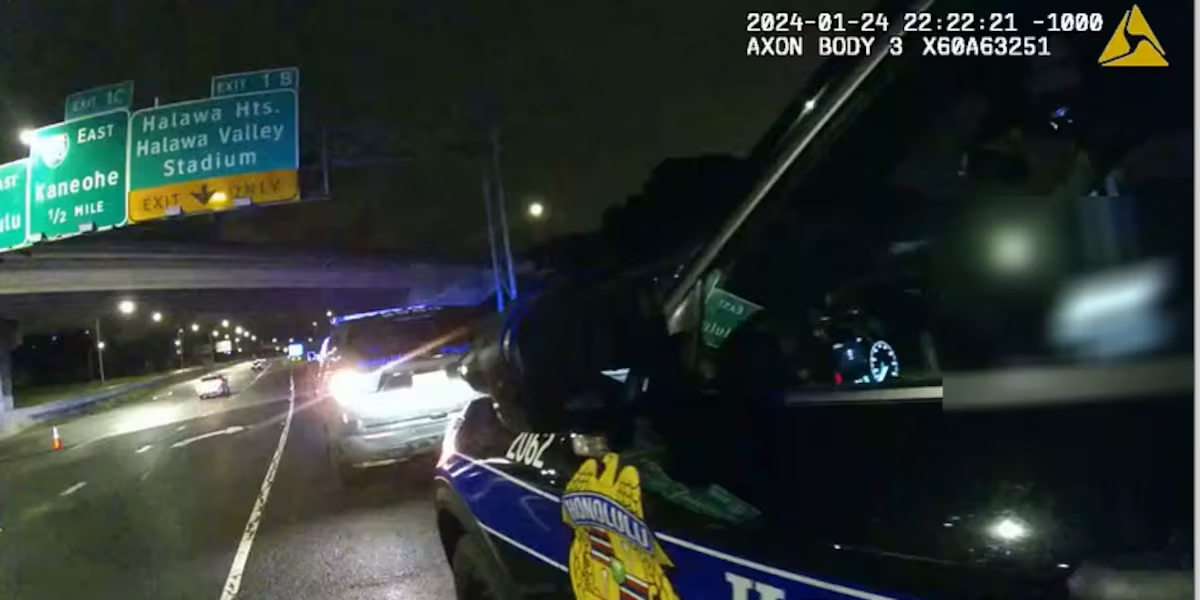
In body camera videos HNN Investigates obtained, drivers who declined were ordered out of the car immediately and arrested.
“Right now, the court is allowed and hearings officers are allowed to take a person’s ‘no’ to perform a voluntary test and use it as a presumption that the person is guilty,” said attorney Kevin O’Grady, who is representing the appellant.
Legal challenge raises constitutional questions
The ACLU of Hawaii joined O’Grady’s challenge. In the court record, agency attorney Emily Hills wrote, “This case raises a significant legal question that could impact the constitutional rights of drivers across Hawaii.”
Hills said drivers have a constitutional right to refuse participation.
“You have a right to say, ‘No, I don’t want to help you prosecute me,’” Hills said. “‘No, I’m not going to participate in my own prosecution,’ whether that’s through remaining silent or through saying, ‘No, I don’t want to do these tests.’”
Hills, who will doing oral arguments before the state high court, said a lower court’s ruling was wrong because it allowed an inference of “consciousness of guilt” from the refusal alone.
Defense attorney and former deputy city prosecutor Victor Bakke said the current system does create an impossible situation for drivers.
Read more Repairs underway of massive Maui sinkhole after March storms
“They’re painting people into a no-win situation,” Bakke said. “If the person takes the test and they fail, they’re going to get prosecuted and it’ll be used against them. But if they don’t take the test, then it’s going to be used against them to say, well, you’re guilty anyways.”
Defense attorney and former Honolulu police officer Jonathan Burge said the “consciousness of guilt” issue contradicts legal advice attorneys give.
“If you’re my client and I told you don’t do it and you’re taking my advice and not doing it, suddenly you got a conscience of guilt when you’re following my advice,” Burge said. “So that doesn’t make sense.”
Not taking the test
O’Grady said there are multiple reasons why a driver might decline the tests beyond guilt.
“They’re tired. They’re scared. Maybe English isn’t their first language. Maybe they’re not good at following instructions, or they have bad knees,” he said.
O’Grady and the other attorneys said the SFST has value and drunk drivers need to be prosecuted, but refusing to participate should not count as evidence.
Hills pointed out that many drivers do consent.
“Lots of drivers say, sure, I’ll do these tests, right, that is an important investigative tool for police,” Hills said. “The flip side is though, if a driver says, no, I don’t want to do them, what are we allowed to read into it and can we hold that against them?”
Read more First Alert Forecast: More trade wind showers and it is the official start to hurricane season
Oral arguments will happen on Thursday.



Post Comment