New report challenges military’s economic impact claims in Hawaii
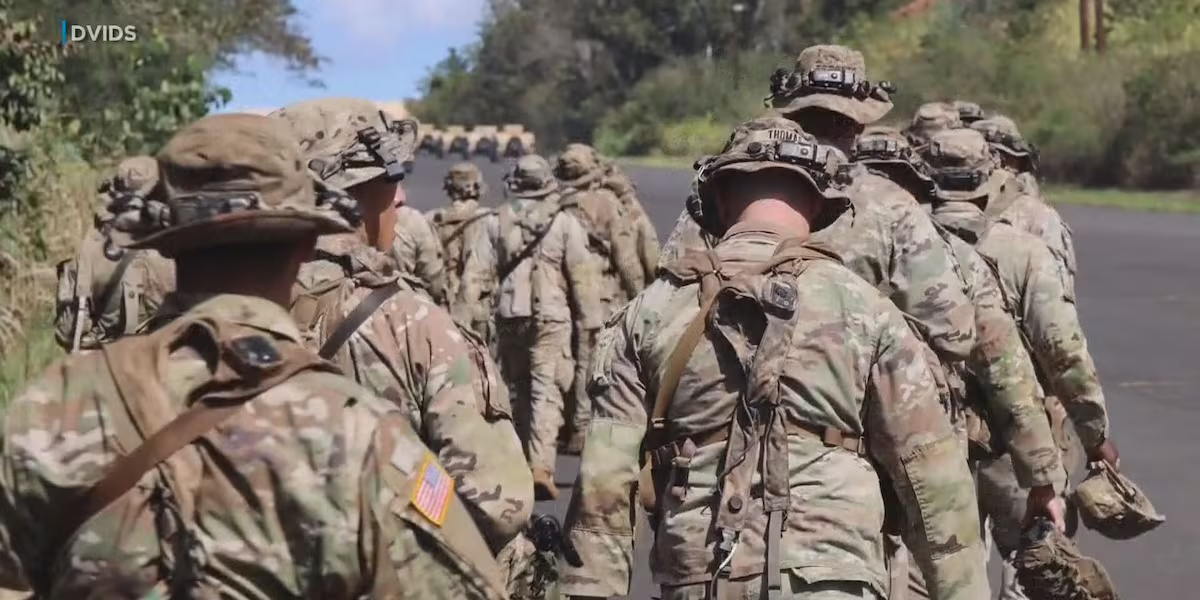
HONOLULU (HawaiiNewsNow) — A group of Hawaii and international experts say expiring military leases on Hawaii’s public lands around 2029 create a once-in-a-generation window to re-examine the costs of the military’s footprint.
Read more Road rage attacker’s California victims feel ‘justice has finally been served’
The report, “The True Cost of the U.S. Military In Hawaii: A Comprehensive Analysis of the Economic, Environmental, Strategic, and Social Impacts of the U.S. Military Presence in Hawaii,” argues the U.S. military presence in Hawaii is larger than necessary, driven by inflated threat assessments, and increases the risk of war with China.
“This report was researched and written to meet the current concerns about the existing military leases. But those leases reflect a small fraction of the lands that the military currently possesses,” said Jon Osorio, dean of the Hawaiinuiakea School of Hawaiian Knowledge at the University of Hawaii Manoa. “I think as a handbook for any of us, Native Hawaiian activists, policymakers, representatives of the government, and even the Army and Navy themselves.”
Economic impact disputed
The report’s key findings put the military’s economic contribution to Hawaii at $7.2 billion — about 30% less than the $10 billion figure cited by the Pentagon and the state.
“The military has been exaggerating the economic benefit by almost 40% or $2.8 billion,” said David Vine, political anthropologist and author of “Base Nation” and “The United States of War.” “They’re doing it not just in Hawaii, they’re doing it across the country, in fact, because they’re making the same claim in every state.”
Vine said every $1 million spent on the military generates about five jobs, while other sectors create more than 12 jobs.
“Almost half of the contractors who get military contracts in Hawaii are based outside of Hawaii,” Vine said.
Read more Washington man formally charged in monk seal harassment case
Land and housing costs
The report says the military owes $133.7 billion in unpaid rent on crown and government lands.
The report also says military demand for off-base housing inflated average Oahu rents by 7.1% in 2024, costing more than $1,848 per household.
PFAS “forever chemical” remediation cost $493 million, the report says.
“There’s still the tremendous insecurity caused by the environmental damage of US military emissions, and the toxins that have been left in the ground and in the water and are in the air in all of the islands, large and small,” said Neta Crawford, professor of international relations at the University of St. Andrews and co-founder of Costs of War.
“The true cost of the military in Hawai’i report is not only about the harms caused by the military, but it’s also about the possibility and hope for our future,” said Davis Price of ʻĀina Aloha Economic Futures.
The groups that co-produced the report are ʻĀina Aloha Economic Futures, the Costs of War Project, ʻĪlioʻulaokalani Coalition, Sierra Club of Hawaiʻi, and the Transition Security Project.
State report shows different figures
In January, the state of Hawaii released its own report on military spending in the islands. The Military and Community Relations Office (MACRO) said the military spent more than $10 billion in Hawaii in 2023, including $1.3 billion in local business contracts. That report said a 10% reduction in force would deal a $1.7 billion blow to the economy.
Read more FAA report: Gusty winds to blame in small plane crash off Kalaupapa
Click here to view the full report.







Post Comment