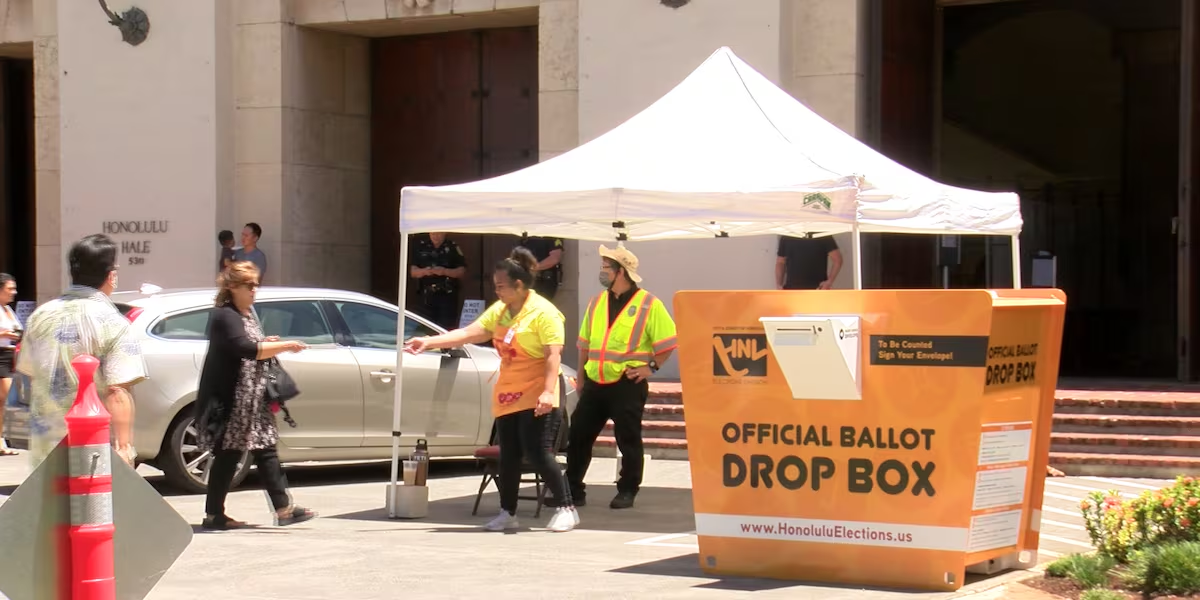
Hawaii officials defend local election security
HONOLULU (HawaiiNewsNow) – Hawaii elections officials are defending the security and integrity of the state’s mail-in voting system, describing multiple safeguards they say protect against tampering and illegal voting.
Read more Rainbow Wahine volleyball team announces 2026 schedule
Honolulu elections administrator Rex Quidilla and state chief elections officer Scott Nago outlined those measures in a Hawaii News Now podcast.
Registration, ID and sworn affirmation
The process begins at voter registration, when voters swear they are eligible and show proper ID. Voters also sign an affirmation on their ballot envelope.
“They swear or affirm. That is how our law is structured. So what they provide us, we take it is true and correct,” Quidilla said.
Providing false information carries legal consequences. Lying on a ballot affirmation is a Class C felony, punishable by up to five years in prison, a fine of up to $10,000, or both.
Nago said that in extremely rare cases, noncitizens have voted because they did not know they were ineligible.
Watch the full interview:
Signature verification and envelope tracking
As ballot envelopes arrive, county officials match signatures on numbered envelopes against signatures on file from voter registration. Scanners flag suspicious signatures for review.
“We are looking for certain attributes that are unique to each signature — stroke, slant, spacing, and whatnot,” Quidilla said.
Read more Drivers asked to slow down after nene, uau killed at Haleakala National Park
If a signature is suspected to be forged, officials contact the voter. Envelopes are stored for years for potential future investigations.
“So if somebody wasn’t supposed to vote, and they did vote, we could find the envelope to show that they did vote,” Nago said.
Voter identifying numbers on envelopes also prevent individuals from voting by mail and then voting in person.
Counting centers and audits
Unopened envelopes are delivered to state counting centers, where they are processed through high-speed scanners that are not connected to the internet.
“It’s a standalone system. The closed system in the counting center,” Nago said.
Audits and recounts have verified the accuracy of the scanners. Members of the state elections commission have questioned what appeared to be discrepancies as ballots move between locations, but Nago said all those discrepancies have been explained. He and Quidilla said the handoff from county to state adds a layer of security.
“We have one part of the puzzle, and then there’s another part of the puzzle that come together to issue election results. That’s a lot of coordination if we want to cheat the system,” Quidilla said.
Nago said outside pressure has not changed the office’s approach.
“We just gonna stay true to our mission. So it really doesn’t matter what the president says or what the pressure is. We just have to make sure we provide secure, accessible and convenient elections,” Nago said.
Read more Hundreds gather in Hawaii for Molokai-2-Oahu downwind foil race
Learn more from the Hawaii Office of Elections website.




Post Comment