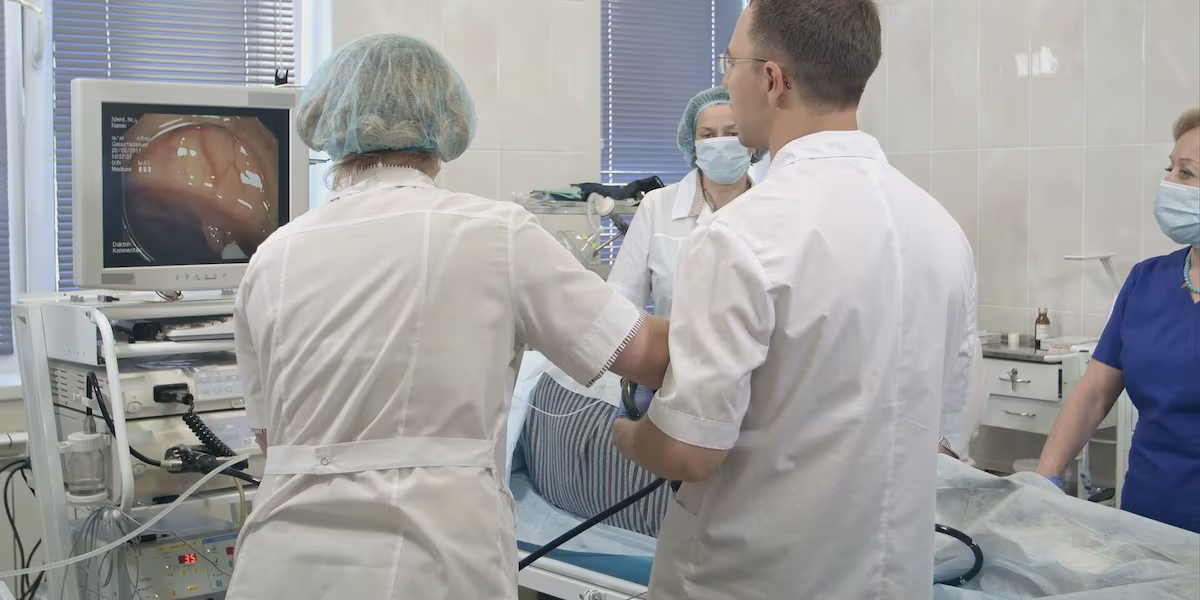
New Hawaii law expands coverage for colorectal cancer screenings
HONOLULU (HawaiiNewsNow) – Gov. Josh Green on Wednesday signed House Bill 1969, a measure aimed at removing financial barriers to colorectal cancer screenings and treatment in Hawaii.
Read more Hawaii students to help draft national AI policy at Boston fellowship
The law requires health insurance plans to cover follow-up colonoscopies after a positive screening test without deductibles, copays or other out-of-pocket costs.
Health officials say the change could save lives by helping patients receive follow-up care sooner.
“I know we don’t like talking about putting a probe up people’s bums, but let’s talk about it. Let’s get people to care. Let’s get the screening done,” Green said during the bill signing ceremony.
For state Rep. Cory Chun, who introduced the measure, the issue is personal. Chun said his uncle died from colorectal cancer earlier this year after being diagnosed at Stage 4.
“He was actually able to survive with the treatment for a few years, but eventually the cancer took over,” Chun said.
Chun said he has spent the past 14 years pushing for similar legislation, arguing that cost and cultural attitudes have kept many people from seeking screenings.
“I think a lot of it has to do with some cultural things too, where we have a hesitancy to see a doctor. We just think we can overcome it or with some time it’ll just go away,” Chun said.
Under HB 1969, the state will also establish a financial assistance program to help uninsured and underinsured residents access colorectal cancer screenings and treatment. The measure appropriates funding to the Department of Human Services to administer the program.
According to health officials, more than 800 people in Hawaii are diagnosed with colorectal cancer each year, and more than 250 die from the disease annually. Experts say cases are increasingly being diagnosed in adults younger than 50.
Read more First Alert Forecast: Passing trade wind showers; warm July afternoons
Dr. Shane Morita, a surgical oncologist and medical officer with the American Cancer Society, said cancer’s impact extends beyond patients themselves.
“My father was one of them 21 years ago, and it affected our entire family,” Morita said. “This will help relieve the burden, the financial burden, the emotional stress.”
Health advocates say colorectal cancer is among the most preventable forms of cancer when detected early through routine screenings.
The law takes effect Jan. 1, 2027, giving insurance providers time to update their plans and coverage requirements.
Additional health-related measures signed into law
Green also signed two other bills to expand health care access and relieve medical debt.
HB 1864, Act 218, requires insurers, mutual benefit societies and health maintenance organizations to cover standard fertility preservation services for individuals undergoing medically necessary treatment that may cause iatrogenic infertility. This requirement applies to all policies, contracts, plans and agreements issued or renewed after Dec. 31, 2026.
Senate Bill (SB) 3025, Act 220, establishes a framework to relieve medical debt for as many as 50,000 Hawaii residents.
The bill requires the Department of Health and Human Services’ Office of Wellness and Resilience to establish and administer a Medical Debt Acquisition and Forgiveness Program to purchase and eliminate outstanding medical debt for state residents, contingent on available program funds. As many as 50,000 residents may qualify, with relief totals reaching as high as $91 million.
Read more Effort underway to revive critical boat ramp on Maui’s north shore






Post Comment