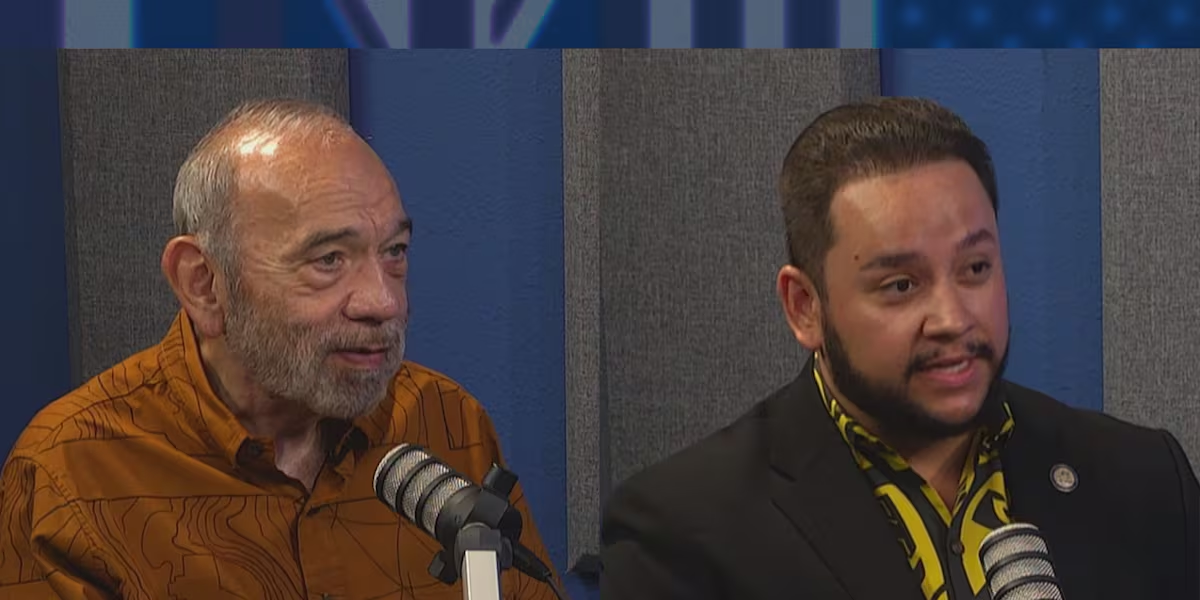
Democratic, Republican leaders offer analysis of primary results, voter turnout
HONOLULU (HawaiiNewsNow) – As primary election results rolled in on Saturday night, prominent Democratic and Republican figures offered contrasting perspectives on what the initial margins say about Hawaii’s electorate.
Read more Incumbents and front-runners lead Maui, Kauaʻi county mayoral primaries
With initial statewide voter turnout hovering at just 28.3%, political analysts and leaders are looking at a quiet election cycle that may mark one of the lowest participation rates in the state’s history.
Turnout apathy and election reform
Former Democratic governor John Waiheʻe, who served as lieutenant governor when the office was directly in charge of elections, suggested that structural changes to how elections are run have subtly depressed turnout.
“With all this talk about registration and citizenship and the rest, this is a completely different era than when I was lieutenant governor and we were in charge of voting and the entire establishment was on the side of driving the numbers up,” Waiheʻe said, comparing modern administrative setups to his time in office.
Waiheʻe argued that having an elected official like the lieutenant governor oversee elections kept a higher degree of accountability.
“The one thing I had to really deal with was the election. So you went out of your way to make sure that whatever you were at, it went well,” Waiheʻe said. “I’ll say it now, okay? That was probably the worst political job I ever had.”
State Rep. Diamond Garcia, assistant House minority floor leader, agreed that the quiet primary season suffered from a deep-seated lack of voter interest.
“It’s a spirit of apathy,” Garcia said of the low turnout. “Why vote? They just feel their voice doesn’t count, it doesn’t matter.”
Garcia also argued that recent legislative efforts designed to automatically boost turnout — such as all-mail voting and automatic voter registration with an opt-out process — are not addressing the root cause.
“You can increase registration, which is what those things try to do, but turnout is a whole different thing,” Garcia said. “What we need, I believe, is a strong two-party system, and that will increase turnout.”
View all election night coverage here.
Local issues and political shifts in West Oʻahu
Garcia highlighted a growing shift in traditional working-class strongholds along the Waiʻanae Coast, ʻEwa, and Kapolei, which historically voted Democratic but have increasingly elected Republicans.
Read more Trevor Ozawa leads Honolulu City Council District 4 race amid legal chaos
“What you saw was in these last few election cycles, the working labor class areas… are now shifting and voting Republican,” Garcia said, pointing to local concerns over the cost of living, parental rights, and municipal neglect.
“West Oʻahu has been looked over for so many years,” Garcia added, noting that parks and public infrastructure in the region have historically lacked the investment seen in East Honolulu.
Both leaders acknowledged an undercurrent of anti-incumbent sentiment within the electorate, though it manifested differently across major races.
On Maui, incumbent Mayor Richard Bissen held an early lead over challenger Yuki Lei Kashiwa Sugimura despite initial polling showing a closer matchup.
“We have an anti-incumbent feeling because it’s about time that the cycle becomes anti-incumbent,” Waiheʻe said. “If you’re going to be mayor and dealing with people on a regular basis, on a daily basis, which every mayor has to do, just going down the street, you’re always going to have to justify the last decision that you make.”
Sylvia Luke’s legal battle and campaign audits
The fallout from Lt. Gov. Sylvia Luke’s recent indictment and exit from the race also loomed large over the evening’s discussions.
Waiheʻe noted that while Luke’s situation was poorly handled, the public and legal reaction may have been disproportionate compared to what other campaigns might face under strict scrutiny.
“I actually would dare anybody else, any major candidate, to submit their campaign spending reports for an audit of the same degree that she had, and to see whether there would be any difference,” Waiheʻe said. He added that because campaigns are run mostly by volunteers, administrative errors are common.
Garcia suggested that seeing a high-ranking elected official face criminal charges has actively contributed to voter distrust and apathy, but maintained that the political system must still be trusted.
“Do I believe there are issues with Hawaiʻi’s election office and system? Absolutely,” Garcia said. “But I’m not gonna sit here and say, if we lose the election, it’s rigged. No, we’ve been able to win races here in Hawaiʻi, and that’s not through calling things rigged. It was through hard work and hard campaigning.”
Read more Incumbent Case wins U.S. House District 1 Democratic primary




Post Comment