Covering the Cost: The cost of defense in the Pacific region and competition with China
In HNN’s livestream show “Covering the Cost with Annalisa Burgos,” we break down the numbers behind Hawaii’s affordability crisis in candid conversations with financial experts, entrepreneurs and community leaders.
Read more Hawaii Island police issue nearly 300 DKI Highway citations
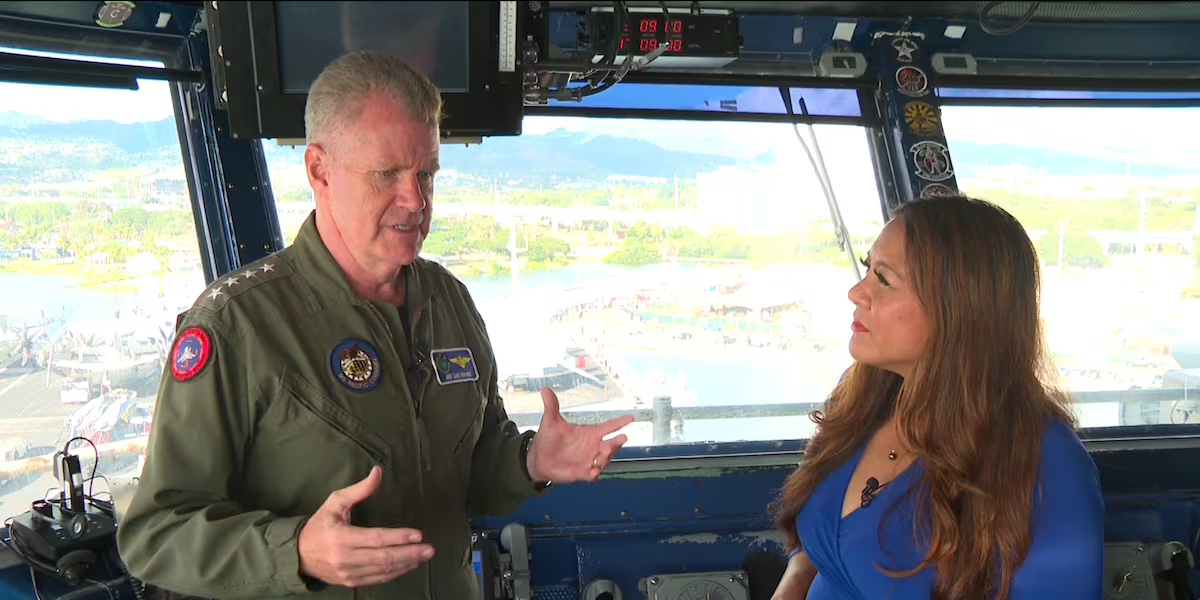
HONOLULU (HawaiiNewsNow) – As the world’s largest maritime exercise, Rim of the Pacific (RIMPAC), wrapped up last week, the head of U.S. Pacific Command Admiral Sam Paparo shared his assessment on security in the region and the cost of defending it.
Aboard the USS Theodore Roosevelt, Paparo spoke in depth with Hawaii News Now’s Annalisa Burgos about the cost of ensuring security in the Pacific region amid increasing competition with China. He makes a strong case for billions in new U.S. weapons spending, including hypersonic missiles and AI-enabled systems.
“It’s the 100th anniversary of the founding of the People’s Liberation Army on August 1, 2027,” Paparo said. “Their leader has declared that by 2027 they shall be ready to execute a unification by force. That’s not a sell-by date. It’s not a deadline. It doesn’t mean that they’re going to go, and it also doesn’t mean there’s not a holiday between now and then, a year before that could potentially happen. It just means that they’ve set that as a marker to be ready, and we have to be readier every day.”
Asked directly whether the U.S. would intervene if China moved on Taiwan next year, Paparo declined to forecast a political decision that ultimately belongs to the U.S. President, but was blunt about military readiness.
“We’re ready. And it’s not a matter of will we prevail. It’s a matter of how much will we prevail by, in terms of the loss, what will we lose en route,” he said. “It’s not my job to sign America up for conflict, and it’s not my job to shrink from it. It’s my job to make sure that the commander in chief has the options that he’s ready to prevail.”
A command spanning more than half the planet
Pacific Command, headquartered at Camp H.M. Smith above Pearl Harbor, is the oldest and largest of the Pentagon’s combatant commands. Paparo described its reach in stark terms: 54% of the globe, 60% of the world’s population, 37 countries, and seven of the world’s ten largest militaries, all under a single four-star headquarters tracing its lineage to Admiral Chester Nimitz and General Douglas MacArthur’s commands in World War II.
Much of that reach was on display this month at RIMPAC, with 30 nations, 35 ships, nearly 190 aircraft and more than 30,000 service members. Paparo said the exercise closed without a single mishap.
“The amount of joint, all-domain training among the nations, it just gets bigger and better every single year, and this is one of the biggest RIMPACs ever,” he said.
The price of deterrence
Earlier this year, Paparo told Congress the U.S. doesn’t have enough warships, and he defended the cost of expanding the fleet, noting China is now fielding more than 800 new missiles a year, a pace he called central to the calculus of deterrence in the Pacific.
“Deterrence is achieved by that ability to demonstrate capability and will,” Paparo said. “It comes down to your ability to either impose costs on an adversary, including in response to aggression. It’s also a big part of defending yourself against missiles.”
Read more Motorcycle crash marks Hawaii Island’s 21st traffic fatality of 2026, man identified
He acknowledged the war in the Middle East, where roughly 20,000 of Pacific Command’s 420,000 assigned personnel are currently deployed, has drawn down some U.S. munitions stockpiles, particularly missile interceptors. He said the Pacific theater relies less on some of the weapons types most heavily used against Iran, such as torpedoes and high-end anti-ship missiles, but that production of interceptors needs to increase regardless.
That spending is showing up across the Pacific. Paparo pointed to a new 360-degree missile defense architecture under construction on Guam, an upgraded Virginia-class submarine base at Naval Base Guam, a new Marine Corps installation at Camp Blaz, and renovations to World War II-era airfields on Tinian, Rota and Saipan in the Commonwealth of the Northern Mariana Islands.
Paparo has also visited Kwajalein Atoll in the Marshall Islands, home to a longstanding U.S. missile test range and governed under the Compact of Free Association, which gives the U.S. responsibility for the islands’ defense and foreign policy.
“Marshall Islanders enlist in the United States military at even higher rates than those do on the mainland,” Paparo said. “It’s a compact of free association, it’s a covenant, and in these dangerous times we’re required to protect each other.”
Philippines and the South China Sea
Paparo also addressed rising tension with China near Scarborough Shoal, ten years after an international tribunal ruled China’s expansive South China Sea claims illegal under a case brought by the Philippines. He said the USS George Washington carrier strike group is currently operating in the South China Sea.
“The purpose of the force that we’ve got in the South China Sea and the Western Pacific is demonstrating the ability to immediately impose costs,” Paparo said, calling it a foundation for a larger force if one is needed, and a way to train alongside allies “so that if the unforgiving hour comes, we’re better aligned in posture to fight together if we must.”
Red Hill still not “resolved”
Closer to home, Paparo addressed the Red Hill fuel storage crisis, which has strained trust between the military and Hawaii communities since contaminated water sickened thousands of military family members in 2021. Asked whether the matter is resolved, he was direct.
“It won’t be resolved until Red Hill is completely closed,” Paparo said. “Certified by the Department of Health as being safely closed, until the wells are back up and running with the treatment, until the monitor wells are all completely drilled and we’re monitoring the situation.”
Paparo took the helm at Pacific Command more than two years ago, after three years as commander of the U.S. Pacific Fleet. He has lived in Hawaii for six years and said his family has deep ties to the local community.
Read more Hawaii to begin nearly $150M broadband expansion for underserved communities




Post Comment