Healthier Hawaii: The opportunities and risks of artificial intelligence in healthcare
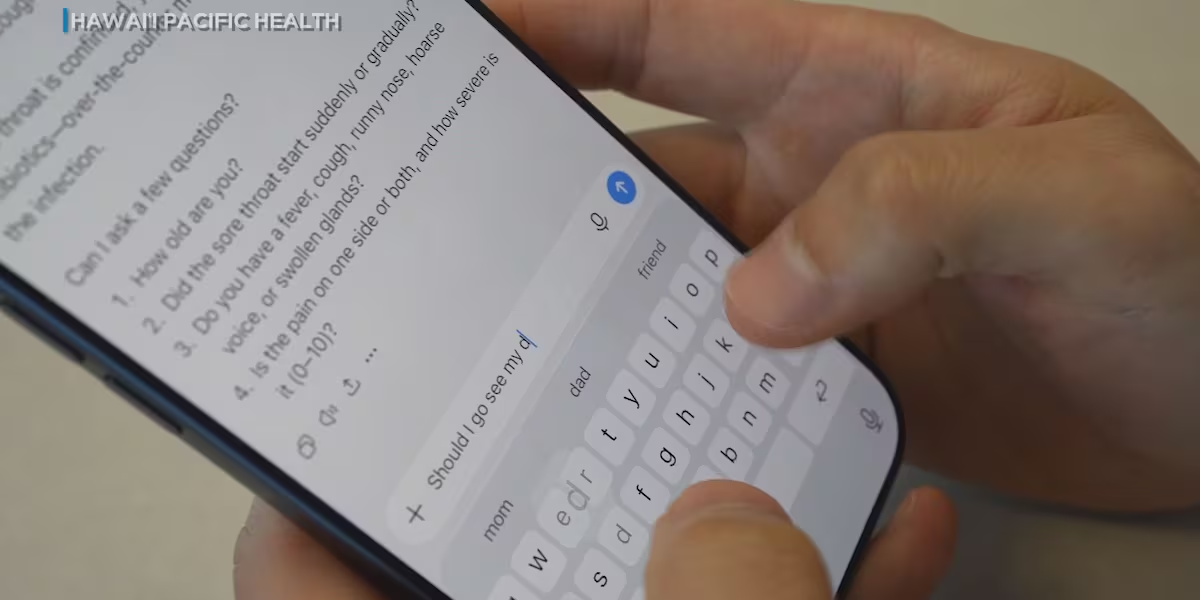
HONOLULU (HawaiiNewsNow) – From automated scheduling to draft emails, artificial intelligence is rapidly integrating into everyday life. But as AI tools become more widespread, health experts in Hawaii are warning patients to exercise caution when using technology for medical advice.
Read more Covering the Cost: The cost of defense in the Pacific region and competition with China
Dr. Sandra Noon, chief of primary care at Hawaii Pacific Health, joined the segment to discuss the growing trend of patients using AI to self-diagnose and navigate their health.
While she acknowledges AI’s potential, Dr. Noon emphasizes that it should never replace a human doctor.
The pitfalls of ‘Dr. AI’
With the rise of sophisticated chatbots, many people are turning to AI when they feel sick or injured. However, Dr. Noon warns that a digital tool cannot replicate the relationship between a patient and a healthcare provider.
“AI can be a great tool, but it should never replace a conversation with your physician or healthcare provider who knows your medical history,” Dr. Noon said.
One of the most dangerous aspects of modern AI is its authoritative tone. Chatbots are designed to generate fluent, highly convincing responses, which can lead patients to trust inaccurate information.
“Even though AI is always improving, it can still make mistakes,” Dr. Noon explained. “One of the biggest concerns is that AI can sound very confident even when it is wrong.”
Because healthcare is highly personal, AI lacks the sensory and contextual capabilities of a medical professional. An AI cannot perform a physical exam, observe subtle nonverbal cues, review a complete and nuanced medical history, or understand a patient’s unique lifestyle circumstances.
This can lead to two dangerous outcomes:
“That is why AI should be viewed as a source of information — not as a substitute for medical care,” Dr. Noon said.
Understanding the source and privacy
Another primary issue with AI tools is the lack of transparency. While some newer models attempt to cite sources, patients often have no way of knowing if the data is current, accurate, or applicable to their specific demographic or region.
“We also know people naturally tend to trust technology when it sounds authoritative,” Dr. Noon said. “If AI presents information confidently, patients may assume it is correct when it may not be.”
Read more Hawaii Island police issue nearly 300 DKI Highway citations
Privacy is another major hurdle. Many users do not realize that typing private health struggles into a public chatbot is vastly different from sharing details in a secure patient portal.
“Many people do not realize that entering health information into an AI chatbot is not always the same as sharing information with your doctor,” Dr. Noon warned. She urges patients to understand how their data is stored, how long it is retained, whether it is used to train future AI models, and what federal oversight is actually in place before uploading sensitive medical history.
The bright side of healthcare technology
Despite the risks for self-diagnosis, Dr. Noon says AI has massive, positive potential to transform clinical operations behind the scenes.
One of the largest benefits is reducing the administrative burden on doctors and nurses. By assisting with automated documentation and charting, AI can free up providers to spend less time typing at computers and more time interacting with patients.
Additionally, AI is proving to be a powerful supportive tool for medical diagnostics.
“When it comes to imaging, AI can be a second set of eyes,” Dr. Noon said. While it won’t replace expert radiologists, AI can assist in analyzing:
The bottom line for patients
Ultimately, Dr. Noon believes AI can be a positive force if it empowers patients to become more proactive and curious about their well-being.
“If AI helps people become more engaged and informed about their health, that is a positive thing,” she said. “Use it to learn about medical conditions, understand medical terminology, and prepare questions for your healthcare team.”
But when it comes to receiving a diagnosis, deciding on a treatment plan, or making critical decisions about your body, she says nothing beats the human touch.
“There is still no substitute for a trusted relationship with your physician or healthcare provider,” Dr. Noon said. “Healthcare is still fundamentally human.”
Read more Motorcycle crash marks Hawaii Island’s 21st traffic fatality of 2026, man identified






Post Comment