Shark Week in Hawaii: Predators play vital role in local ocean health, culture
HALEIWA (HawaiiNewsNow) – Shark Week puts sharks in the spotlight each summer. In Hawaii, the bigger story may be what they reveal about the health of the ocean — and the state protections already on the books to help keep them there.
Read more Maui youth program receives 200 soccer balls from FIFA World Cup donation
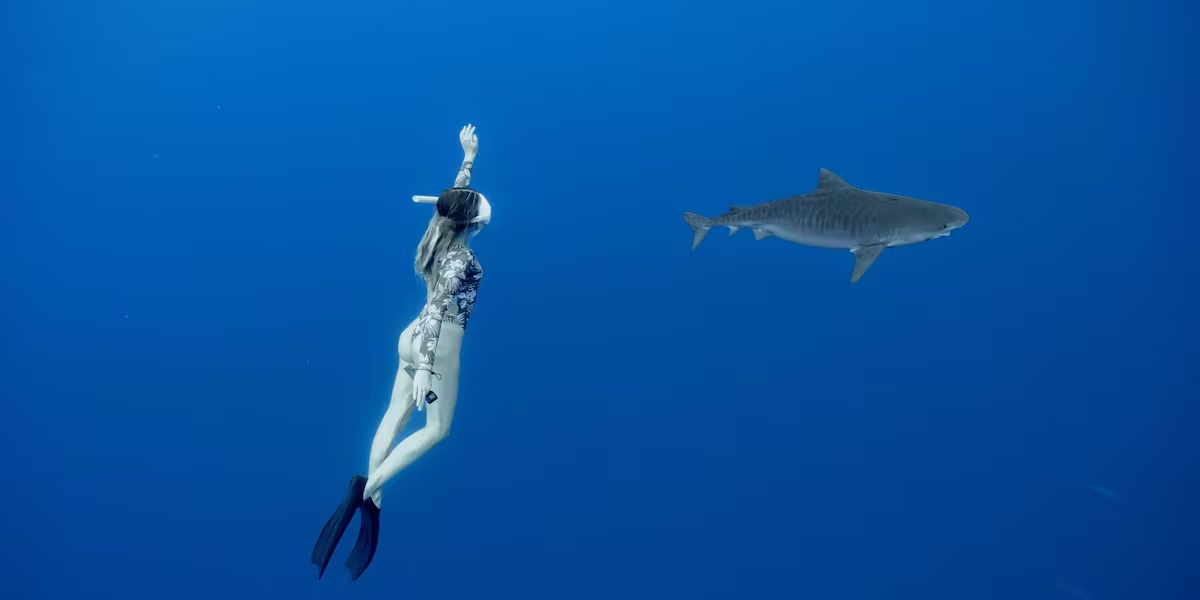
I felt that up close Sunday while freediving off Oahu’s North Shore, where I swam in open water alongside five tiger sharks and one Galapagos shark. One tiger shark, known as “Pistachio,” was described by guides as pregnant and roughly 17 feet long.
The encounter was intense and surprisingly calm. It also underscored a point marine conservationists have been making for years: sharks aren’t just headline-grabbers. They are key to keeping island waters in balance.
What sharks do for Hawaii’s waters
Marine scientists aboard Go Adventure Hawaii describe sharks as important predators in many ecosystems, affecting prey behavior and removing weak or sick animals — dynamics that can shape reefs and fisheries.Researchers note that when top predators decline, ecosystems can shift in ways that ripple through food webs.
The Hawaii Department of Land and Natural Resources’ Division of Aquatic Resources (DLNR) says Hawaii is home to about 40 different species of sharks; commonly encountered species include tiger sharks, Galapagos sharks, and sandbar sharks, among others.
When asked why she loves the work, Nicole Cook, a safety diver with Go Adventure Hawaii and a marine biologist, said each day on the water is unique.
“Each dive is so different, seeing how they react to different things — like a leaf floating in the water — or just with each other in the different ocean conditions,” Cook said.
Sharks — manō — also hold deep cultural significance in Hawaii, tied to stories, beliefs and practices that treat them with respect rather than fear.
Hawaii’s shark fishing ban: what’s legal, what isn’t
State law now offers broad protections. A measure passed by the 2021 Legislature, Act 51 (House Bill 553), made it illegal to knowingly capture, entangle or kill a shark in state marine waters.
According to Hawaii DLNR, the law does not apply in certain situations, including:
Why shark conservation is hard — and urgent
On our ride back into the harbor, the Go Adventure Guides took a moment to teach us about ongoing conservation efforts and what we can do to help protect manō.
Sharks generally grow slowly and produce relatively few young compared with many fish species. Learning that made seeing a pregnant tiger shark feel even more significant. When shark numbers drop, conservationists say rebuilding can take years.
Read more Researchers study first known blacktip shark nursery in Hawaiian waters
Guides on the boat raised concern about what they called a “labeling loophole,” saying vague terms like “ocean fish” or “white fish” can show up on menus or packaging and make it harder for consumers to know exactly what they’re eating. Their advice: Look for the exact species (like mahi mahi, ahi/tuna or salmon) and ask questions when it isn’t listed.
They also urged shoppers to check cosmetics and personal care products for squalene or squalane, ingredients sometimes derived from sharks.
What it’s like to meet a tiger shark underwater
From the surface, a large shark can look ominous in dark water. Underwater, the experience felt different: smooth movement, steady pacing and a kind of curiosity.
The sharks I saw didn’t match the movie thriller image like I saw growing up. They passed by without even acknowledging me, slowly and gracefully.
“People think that sharks are these man-eating monsters and they’re really scared because of what they see of them in movies or shows,” Cook said. “We like to show people that they’re actually just curious animals and not out to get us.”
Seeing Pistachio, and thinking about a pregnant tiger shark moving through North Shore waters, made the broader conservation message feel less abstract. These aren’t just symbols or statistics. They’re living animals, and Hawaii is part of their story.
The takeaway for Shark Week
Shark Week is an opportunity to learn more about these often-misunderstood creatures. When I did so – it was with awe and responsibility.
If the islands want healthy reefs, resilient fisheries and thriving marine ecosystems, protecting apex predators like sharks is part of the job.
I left the water with a shift in perspective, wondering what else I’d been taught to fear before taking the time to understand it.
“There are usually around seven to 10 deaths per year worldwide from shark attacks, but that’s a very low number compared to other risks,” said Maria Perez-Varona, part of the Go Adventure Hawaii crew and a marine biologist. “A coconut hitting you on the head is more likely to kill you than a shark attack.”
Read more Hawaii delegation asks president to approve disaster aid after 6.0 earthquake





Post Comment