
HPD doubles Crisis Intervention Team, expands MH-3 program across Oahu
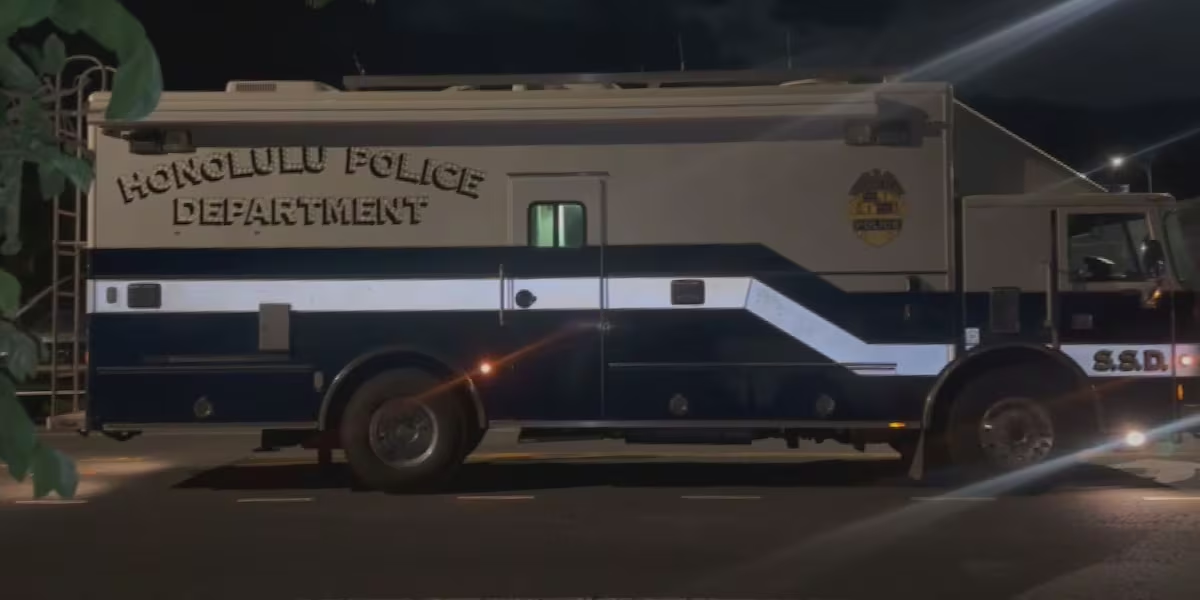
HONOLULU (HawaiiNewsNow) – The Honolulu Police Department has doubled the number of officers on its Crisis Intervention Team, a unit specially trained to work with people in mental distress or suffering from substance abuse issues.
Read more Army’s 25th Infantry Division holds change of command ceremony
CIT officers also work alongside the Community Outreach Response and Engagement Team (CORE) with a focus on the homeless population and the MH-3 process.
The MH-3 program, which started as a pilot, is now permanent and expanding throughout Oahu.
The teams have doubled efforts, from twice a week to four times a week, and will operate in all six police district on Oahu.
Officers, CORE respond to calls
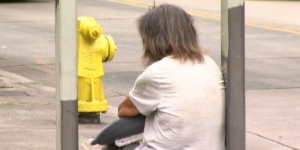
During one response at Paki Park in the Kapahulu area, CIT officers spent 30 minutes speaking with a woman living at the park. Despite her initial objections, she agreed to go with CORE in an ambulance to be evaluated. Her belongings went with her in a CORE pickup truck.
Under the MH-3 process, her only other option was transport in a patrol car in handcuffs.
Maj. Paul Okamoto said the conditions facing people living outside are difficult.
“It’s not an idyllic existence out here, right? It’s a very rough existence. A lot of bad things happen, especially to females,” Okamoto said.
The woman, who apparently couldn’t use her left arm, wore a knife around her neck in a sling so she could have it close to her at all times. She also carried pepper spray.
Earlier the same day, teams responded to a partially naked woman near the Ala Wai, taking her for an evaluation.
And an hour later, a man with injuries to his foot and face on Kuhio Avenue also declined to leave initially, but ultimately accepted the CORE option.
Diverting people from emergency rooms
Jon Kurosu, District Chief of CORE, said the goal of the program is to connect people with appropriate care.
“They need the services, but they’re just adamant about not going, whether it be from mental illness or other histories that happened in their life. So to use this avenue to get them into that first step and this turns into the next step,” Kurosu said.
Read more Families of couple killed in Kauai helicopter tour crash file wrongful death lawsuit
Kurosu added that the program aims to preserve emergency room capacity. Most of the patients are taken to the Behavioral Health Crisis Center for a physician’s exam. If the patient needs a higher level of care, they are transported to the hospital.
Instead of being discharged back onto the streets, many end up in respite centers which are staffed with a doctor, nurses and other medical staff.
“Our goal is always to save the ER services for the highest need and divert them to the resources that can service them,” he said.
Trevor Abarzua, president and CEO of the Waikiki Improvement Association, said that before the MH-3 law took effect in January, the vast majority of people in crisis refused help.
“We would probably see about a 90 to 95% of people saying, no, I don’t want help, right? And they probably needed it,” Abarzua said.
Abarzua said he has seen a significant decline in the homeless population in Waikiki, especially those who yell at residents, visitors and workers.
Critics of the MH-3 program say it criminalizes homelessness
Last year, the Legislature passed Senate Bill 1322, which became Act 219.
The law allows a doctor or crisis intervention worker to enact an MH-3 if they believe a person is mentally ill or suffering from substance abuse and is a danger to themselves or others.
That person can be detained if they don’t go voluntarily for an emergency exam at a facility such as the Behavioral Health Crisis Center or a hospital.
The measure had support from many lawmakers, state leaders and some community groups, in part because it relies on additional and upgraded respite centers as alternatives to the state hospital or jails.
But there was opposition. The ACLU of Hawaii was one of the groups that submitted testimony saying the “Hawai’i Courts have consistently held that involuntary commitment statutes result in significant deprivation of liberty interests and require due process safeguards.” The written testimony also cited the potential for health privacy violations.
Representatives from ACLU of Hawaii and other opposition groups either declined to comment for this report or did not respond.
Read more 80-Year-Old Fitness Instructor Proves ‘Movement is Medicine’ at Ko Olina




Post Comment