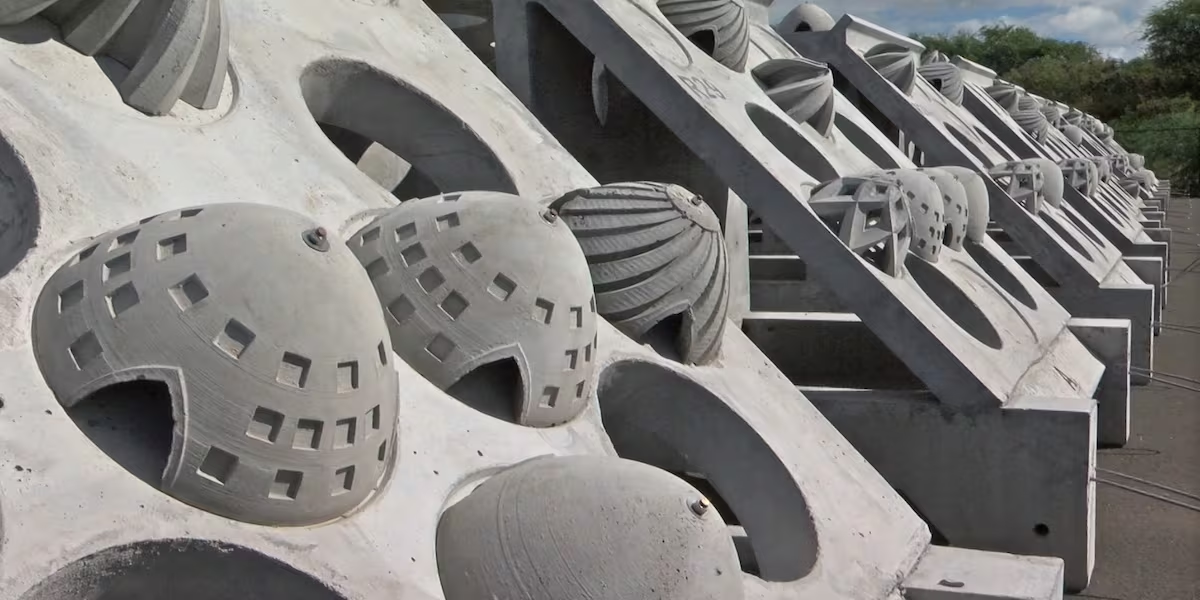
Hawaii tests ‘living breakwater’ to hold back the sea
HONOLULU (HawaiiNewsNow) – There is a new approach to protect Hawaii’s shorelines from erosion.
Read more UH researchers awarded $3.6M to study legacy pollution, health risks
After years of research and planning, a “living breakwater” will soon be sitting on the ocean floor off Kalaeloa.
Sixty concrete reef structures will sit in an underwater site about two-thirds the size of a football field, south of Kalaeloa Harbor.
“Who would have thought, I was talking to some folks prior, I told my ancestors that we’re putting cement in the ocean to save our reef?” said state Rep. Darius Kila, chair of the House Transportation Committee.
Project aims to reduce storm damage
The goal of the Kalaeloa Hybrid Reef Project is to create a healthier marine habitat while reducing the power of waves that erode the shoreline.
Hurricane Lowell just showed the immense amount of damage that storm surges can do.
“This post-storm, we’ve lost so much more shoreline and we cannot wait any longer to lose any more shoreline. Farrington Highway was inundated with water, right?” Kila said.
The University of Hawaii Applied Research Laboratory said testing has shown results in scale models.
“We’ve shown these to dissipate 80 to 90 percent of wave energy in a scale models of these in a wave flume. And this will be the first test in real world conditions during this deployment where we can measure how these reduce those incoming waves,” said Ben Jones, the laboratory’s director of Ocean Science and Technology.
State, federal partners developed structures
The Hawaii Department of Transportation launched the project with federal funding from the Defense Advanced Research Projects Agency, along with years of work from partners including the University of Hawaii, Makai Engineering, and Kuleana Coral Restoration.
Read more First Alert Forecast: Heavy Showers Just Offshore of Hamakua Coast
The structures were designed to mimic a living reef over time.
“They’re habitat structures, so they’re designed to encourage coral larva to settle into those structures. So the reason they have these crevices is juvenile baby coral love to look for a little crevice where they can hide from predators,” Jones said.
The project includes a special method to attract coral to the site.
“There will be a speaker under the water that will play sounds that have been recorded from another area of a healthy reef,” Jones said.
Community input shaped project
The project also looked for guidance from Oahu families who have long called this area home.
“I never really understand because I didn’t know why they wanted to put something fake in the real. But when they explained to me that this is to help protect the coast, then I was in because you got to grow with technology,” said cultural environmentalist Damon Duhaylonsod. “So when I saw this, I was envisioning, I can see the fish, I can see the limu, I can see the wana, the coral attaching.”
Long-term monitoring planned
A large catamaran will be used to carry the multi-ton structures out to sea.
Over the next year, state funds from the new Green Fee will be used to monitor and maintain the project.
The findings will be shared with regulators, engineers and coastal managers. If successful, the Kalaeloa Hybrid Reef could be replicated elsewhere.
“It’s a real world test of how we can protect critical transportation infrastructure while working with nature, rather than against it,” said state Sen. Lorraine Inouye, chair of the Senate Transportation Committee.
The newly established Kalaeloa Hybrid Reef Monitoring Hui, a partnership of researchers, agency representatives, community organizations and cultural practitioners, will be monitoring the project long term.
Read more Police investigate after man found dead with suspicious injuries at Hilo park



Post Comment