With Taiwan bracing for potential invasion, U.S. PACOM chief pushes for more Pacific defense spending
HONOLULU (HawaiiNewsNow) – Taiwan is holding its annual war games this week — its largest to date — with soldiers and civilians preparing for a possible invasion by China, which claims the self-governing island as its territory.
Read more Republican candidates observe recount for two primary races at state Capitol
The defensive drill comes as a critical date approaches for China that could have a major impact on the Pacific and Hawaii — home to U.S. Pacific Command (PACOM), which would oversee America’s military response should Taiwan be attacked.
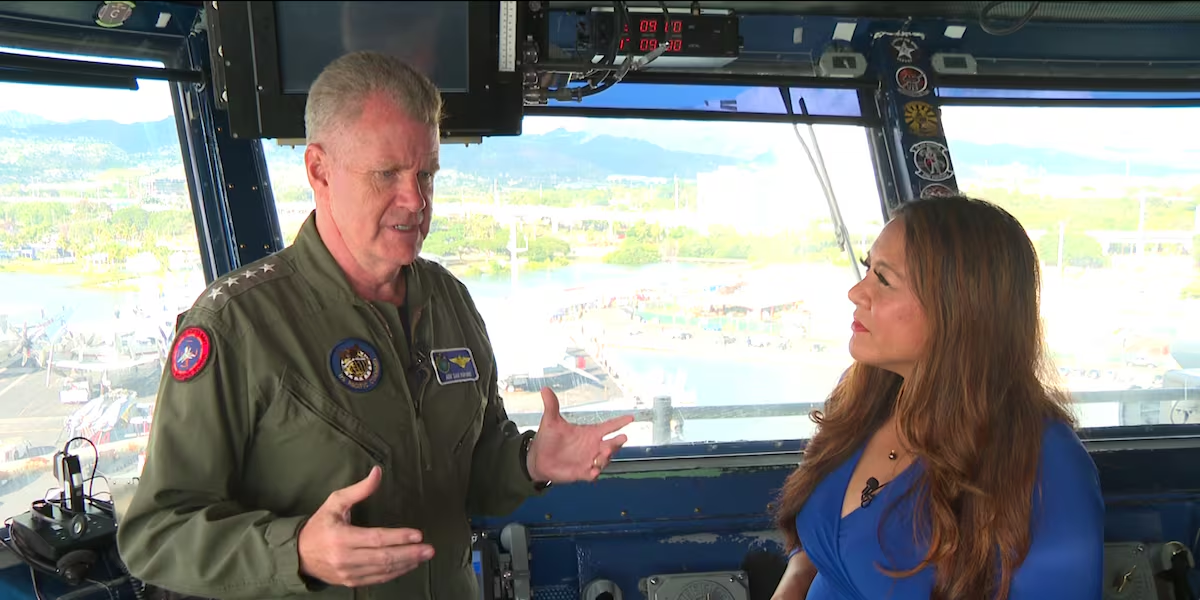
U.S. Pacific Command chief Admiral Samuel Paparo spoke exclusively to Hawaii News Now’s Annalisa Burgos aboard the USS Theodore Roosevelt about deterrence and what it takes to avoid war with China.
The aircraft carrier served as a central command hub during the recent RIMPAC exercise in Hawaii, which is billed as a critical part of combat readiness training for the U.S. and its allies. Being ever-ready is key with China touting its own readiness target date to take back Taiwan.
August 1, 2027, marks the 100th anniversary of the Chinese Communist Party’s People’s Liberation Army.
“Their leader has declared that by 2027 they shall be ready to execute a unification by force,” Paparo explained.
While Paparo says it’s not a deadline for an attack, he uses it as a benchmark in his case to Congress for more defense spending and base investments in the Pacific — even as global conflicts strain America’s weapons stockpiles.
“China is building 800+ missiles per year and so the ability to defend that, the ability to impose costs,” he added. “There are so many guided missile destroyers here in Pearl Harbor and a significant purpose for them is to be able to defend Hawaii and to defend Guam, the Marianas, our allies and partners from missile attack and from air attack.”
That’s why Paparo is asking Congress for about $122 billion for new missiles, hypersonic weapons, drones and AI-enabled systems, to keep pace with China’s fast-growing military, which now has more ships than the U.S.
Read more First Alert Forecast: Waiting for Lala
“We have to increase our rates of production of those interceptors and more importantly. We’ve got to pursue the more innovative non-traditional capabilities that reflect this changing technological epoch that we live in,” Paparo said.
And as Taiwan rehearses its defense, the role the U.S. would play in a real-world conflict remains up to the commander-in-chief.
When asked if the U.S. is ready to intervene, Paparo said “We’re ready. And it’s not a matter of will we prevail — it’s a matter of how much will we prevail by, in terms of the loss, what will we lose en route.”
The U.S. is also helping the Philippines, which faces Chinese aggression and expansion into its sovereign territory in the South China Sea, despite an international court ruling that China’s claims are illegal.
The USS George Washington strike group is deployed there — a direct signal to China.
“The purpose of the force that we’ve got in the South China Sea and the Western Pacific that’s there, demonstrating the ability to immediately impose costs,” Paparo said. “And if the unforgiving hour comes, we’re better aligned in posture to fight together if we must.
President Donald Trump is expected to submit a $14 billion Taiwan arms package to Congress soon, and could use it as leverage when he meets with Chinese President Xi Jinping at the White House next month.
Read more South Kihei Road reopens ahead of schedule following Kona low repairs




Post Comment