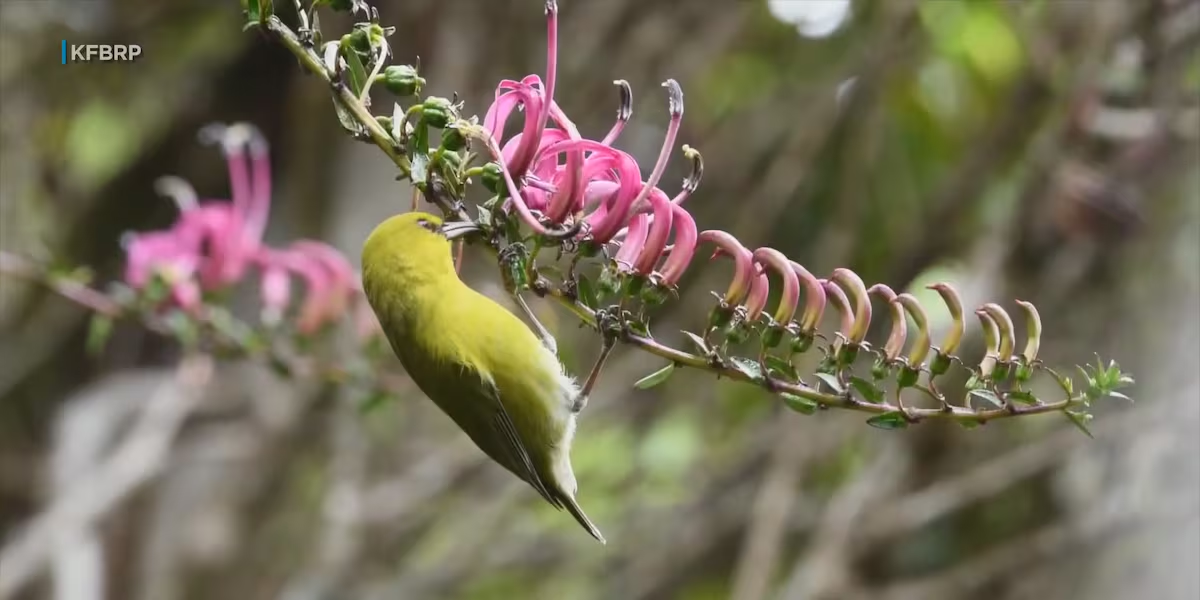
Researchers warn Kauai honeycreepers are disappearing faster than expected
HONOLULU (HawaiiNewsNow) – Researchers tracking Kauaʻi’s native honeycreeper birds say multiple species are vanishing faster than expected, and that the ʻakikiki may no longer exist on the island.
Read more East Honolulu voters, candidates react with confusion after judge bars Waters from ballot
“It is possible that for the first time in human history, there is not an ʻakikiki on Kauaʻi,” said Justin Hite, mosquito project coordinator for the Hawaiʻi Division of Forestry and Wildlife.
Hite said the ʻakikiki has not been seen in about a year. “There are no more ʻakikiki — the last single ʻakikiki was seen about a year ago,” he said, noting that there may be “only one or two remaining.”
Survey data shows sharp declines
Two other honeycreeper species once considered fairly common — the ʻanianiau and Kauaʻi ʻamakihi — are also in decline, according to researchers.
Lisa “Cali” Crampton, program manager for the Kauaʻi Forest Bird Recovery Project, said survey data previously showed about 3,500 ʻanianiau and about 9,000 Kauaʻi ʻamakihi.
“While we haven’t conducted another official range-wide survey this year, the raw data we have suggests that we are now looking at hundreds of both bird species — not thousands — in the span of just two or three years,” Crampton said.
“So really, really steep and disturbing declines in those two species,” she said.
Researchers said they had previously estimated the birds had five to 20 years before reaching critical levels, but said the species are now gone from many areas where they were formerly detected.
“Areas in the middle of the Alakaʻi (forest) that’s just empty now of birds is incredibly painful for those of us who’ve worked back there a lot,” Hite said.
Mosquito-borne disease a likely factor
The U.S. Fish and Wildlife Service reports that 23 species of honeycreepers have gone extinct in Hawaii since mosquitoes arrived in the early 1800s.
Honeycreepers have historically lived in cool, high-elevation areas where mosquitoes could not survive. Researchers said warming temperatures have allowed invasive mosquitoes to move higher, increasing exposure to avian malaria and avian pox.
Crampton said mosquito-borne diseases are likely part of the recent population drop, though the exact cause of the sudden decline between 2023 and now has not been fully determined.
“What caused this sudden dip from one year to the next or from 2023 to now, we cannot be entirely certain, except to say that mosquito-borne diseases are likely part of it,” she said.
Crampton also said other factors can affect birds in some years, including a lack of food, heavy rainfall that can cause nests to fail, and strong winds that can destroy nests.
Read more Bishop Michael Thomas Tupou Castori ordained, installed to lead Honolulu diocese
Conservation breeding and translocation plans
Starting in September, crews plan to capture wild ʻanianiau and Kauaʻi ʻamakihi and collect their eggs.
The birds will be placed in conservation breeding facilities at the Honolulu Zoo and in mosquito-free habitats on Maui and Hawaiʻi Island.
Hite said those locations were chosen because their forests extend to elevations where mosquito breeding remains limited.
Crampton said the long-term goal is to return the birds to Kauaʻi.
“Until this year, we thought we had thousands of Kauaʻi ʻamakihi. We didn’t need to do anything at all,” Crampton said.
“When we’ve controlled the threats in the wild and it’s safe for them to return, the plan is definitely to return them to Kauaʻi where they belong,” she said.
Funding and how residents can help
Some funding for the effort will come from Hawaiʻi’s new Green Fee fund to support environmental conservation.
Hite said the funding will help with translocating Kauaʻi ʻamakihi and ʻanianiau, setting up aviaries on Kauaʻi, and developing models to predict when and where mosquito outbreaks could happen.
“We feel like that’s really the intent of the Green Dee is to be able to do this kind of work to save things that are so important to Hawaiʻi and to the ʻāina,” Hite said.
Researchers also warned that honeycreeper populations on Maui and Hawaiʻi Island could face similar threats without urgent action to control avian malaria.
“There is no safe harbor on Kauaʻi,” Hite said. “Whereas on Maui and on Hawaiʻi Island, there’s still so much great forest where the birds can still hide and be protected from mosquitoes.”
Researchers said homeowners can help reduce mosquito breeding by eliminating standing water, including in trash can lids, flower pots, and wheelbarrows.
“You’ll be a lot happier for it, because they won’t be biting you,” Crampton said. “But the birds will be a lot happier for it too.”
Read more Spotlight Now: Honolulu Mayor Rick Blangiardi and new Police Chief David Lazar




Post Comment